Founding & Origins (1986)
Thalamus Ltd was established in 1986 as the in-house software publishing label of
Newsfield Publications Ltd, the British company headquartered in Ludlow, Shropshire,
that published two of the most important magazines in British gaming history:
Zzap!64 and CRASH.[1]
The company operated out of Canonbury, North London, with its directors
Andrew Wright and Gary Liddon bringing complementary
skills to the venture. Wright, formerly a PR Manager at Activision, understood the
commercial landscape of British games publishing. Liddon, who had served as a technical
writer and reviewer for Zzap!64, understood what made great C64 software.
Together they formed one of the most artistically successful publishing partnerships
in the history of the Commodore 64.[2]
The name "Thalamus" — referring to the region of the brain that acts as a relay centre for
sensory information — suggested ambition and intellectual intent from the outset. This was
not a publisher content to churn out budget titles. From its very first release, Thalamus
demonstrated a commitment to technical excellence and artistic ambition that would define
its entire catalogue.
The Zzap!64 Connection & Controversy
Thalamus's relationship with Zzap!64 magazine was both its greatest structural
advantage and the source of its most significant controversy. As a label owned by Newsfield,
Thalamus had direct access to the C64 development community and the reviewers who shaped
public opinion about new software. Gary Liddon's background as a Zzap!64 staff writer
meant he had personal relationships with the developers whose work the magazine covered —
a network that proved invaluable in signing talent.[1]
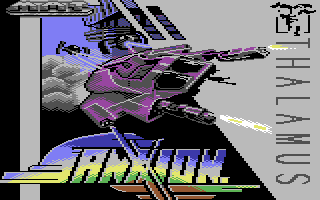
The conflict of interest became explicit with Thalamus's debut release, Sanxion (1986).
The game received a Gold Medal and ecstatic review in Zzap!64 — a publication whose
parent company owned the game's publisher. The magazine's normally rigorous editorial
independence was thrown into question. Critics within the industry noted the impossibility
of objective reviewing under these circumstances.[2]
The controversy deepened further when Zzap!64 released a cover cassette titled
"Thalamusic" — featuring Rob Hubbard's iconic Sanxion title track as its
headline piece. The promotional synergy between the magazine and the label it owned was
undeniable, and the episode remains a defining example of the publisher-press conflicts
that characterised British gaming media in the 1980s.
Key People
Thalamus's catalogue was defined by a small constellation of extraordinary programmers,
composers, and artists who produced work that still stands as some of the finest on
any 8-bit platform.
Andrew Wright
Director
Former Activision PR Manager who co-founded Thalamus and managed its commercial operations.
His industry experience shaped Thalamus's professional profile in the competitive
British games market of the late 1980s.
Gary Liddon
Technical Executive
Former Zzap!64 staff writer whose technical knowledge and developer relationships
were central to Thalamus's success. Co-developed the Mix-E-Load system for Delta
and had a talent for identifying exceptional programming talent.
Stavros Fasoulas
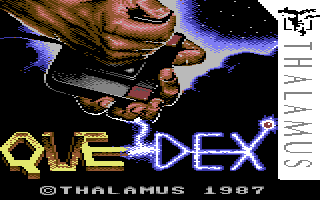
Programmer — Sanxion, Delta, Quedex
Finnish programmer responsible for Thalamus's first three releases. A prodigious talent
who combined C64 technical mastery with strong game design instincts. Departed after
completing Quedex to fulfil his compulsory Finnish national service
obligations.[2]
Rob Hubbard
SID Composer — Delta, Sanxion
One of the most celebrated SID chip composers of the C64 era. His soundtrack for
Delta, influenced by the ambient work of Pink Floyd and Philip Glass, is
considered one of the greatest pieces of C64 music ever written. His title track
for Sanxion — "Thalamusic" — was popular enough to receive its own
cassette release.[3]
Martin Walker
Programmer & Composer — Hunter's Moon, Armalyte
Highly versatile developer who programmed Hunter's Moon solo and contributed
additional code and the entire musical score to Armalyte. Walker's compositional
work on Armalyte matched the extraordinary quality of the game's visuals and programming.
Cyberdyne Systems
Developers — Armalyte
The development duo of Colin Dooley and Daniel Emmerson,
trading as Cyberdyne Systems, created Armalyte — widely considered the finest
shoot-em-up ever released on the C64. Their technical achievement in sprite handling
and smooth scrolling was exceptional.
The Rowlands Brothers
Developers — Retrograde, Creatures, Creatures II
Steve and John Rowlands pushed the aging C64 hardware further than almost any other
developers. Their work on Creatures and its sequel produced graphics that
rivalled 16-bit machines, using sprite multiplexing and colour cycling techniques
of extraordinary sophistication.[2]
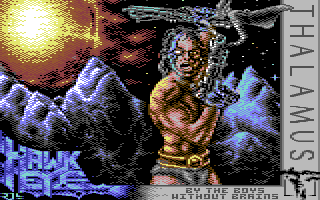
Boys Without Brains
Developers — Hawkeye
A Dutch demo-scene collective who demonstrated that demo-scene programming excellence
could translate directly into commercial game development. Their work on Hawkeye
brought a distinctly European sensibility to Thalamus's catalogue.
Nick Pelling
Concept — Mix-E-Load
Although not a Thalamus developer, Pelling's BBC Micro programming work provided the
conceptual inspiration for the Mix-E-Load system. His earlier experiments with
interactive loading screens informed Gary Liddon and Rob Hubbard's groundbreaking
implementation in Delta.[4]
The Mix-E-Load Innovation
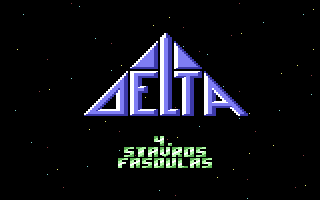
Of all Thalamus's innovations, none was more audacious or more beloved than Mix-E-Load,
introduced in Delta (1987). At its heart, Mix-E-Load was a solution to one of the C64's
most persistent frustrations: the interminable wait while games loaded from cassette. But where
other publishers offered a static loading screen or a simple tune, Thalamus and developer
Stavros Fasoulas — working with Gary Liddon and Rob Hubbard — created something unprecedented.
The concept originated from the work of Nick Pelling, a British programmer renowned for his
BBC Micro contributions, who had explored interactive loading screen possibilities on that
platform. Liddon recognised the potential and worked with Hubbard to implement a C64 version
of extraordinary sophistication. The result: while Delta loaded in the background,
players could interact with a fully functional music remixer.[4]
Players could manipulate individual channels of Rob Hubbard's Delta soundtrack in real time —
adjusting volumes, switching between musical phrases, altering tempo. The SID chip's three-voice
architecture was exposed as a creative instrument, not merely a playback device. Every loading
session became a unique musical experience. For C64 owners accustomed to staring at static
screens, Mix-E-Load was a revelation. It remains one of the most creative uses of "dead time"
in the history of video games.
Rob Hubbard & the Delta Soundtrack
Rob Hubbard's soundtrack for Delta occupies a unique position in C64 music history.
Hubbard was already recognised as one of the platform's preeminent composers when he approached
the Delta score, but the music he produced for the game represented a significant departure from
conventional game music of the era.
Drawing on influences from Pink Floyd's atmospheric rock and
Philip Glass's minimalist classical compositions, Hubbard created a score of
unusual depth and emotional range. Where C64 game music was often functional and energetic,
Hubbard's Delta themes were meditative, layered, and genuinely affecting. The SID chip's
limitations were transformed into aesthetic virtues: its characteristic envelope decay and
filter resonance became expressive tools rather than technical constraints.[3]
The music was not merely incidental to the Mix-E-Load experience — it was its centrepiece.
The fact that players could remix and manipulate these tracks made them engage with the music
as active participants rather than passive listeners. Decades later, the Delta SID recordings
are still celebrated in the C64 community, and Hubbard's work for Thalamus remains among the
most discussed and studied music in 8-bit gaming history.
Armalyte and the Commercial Peak
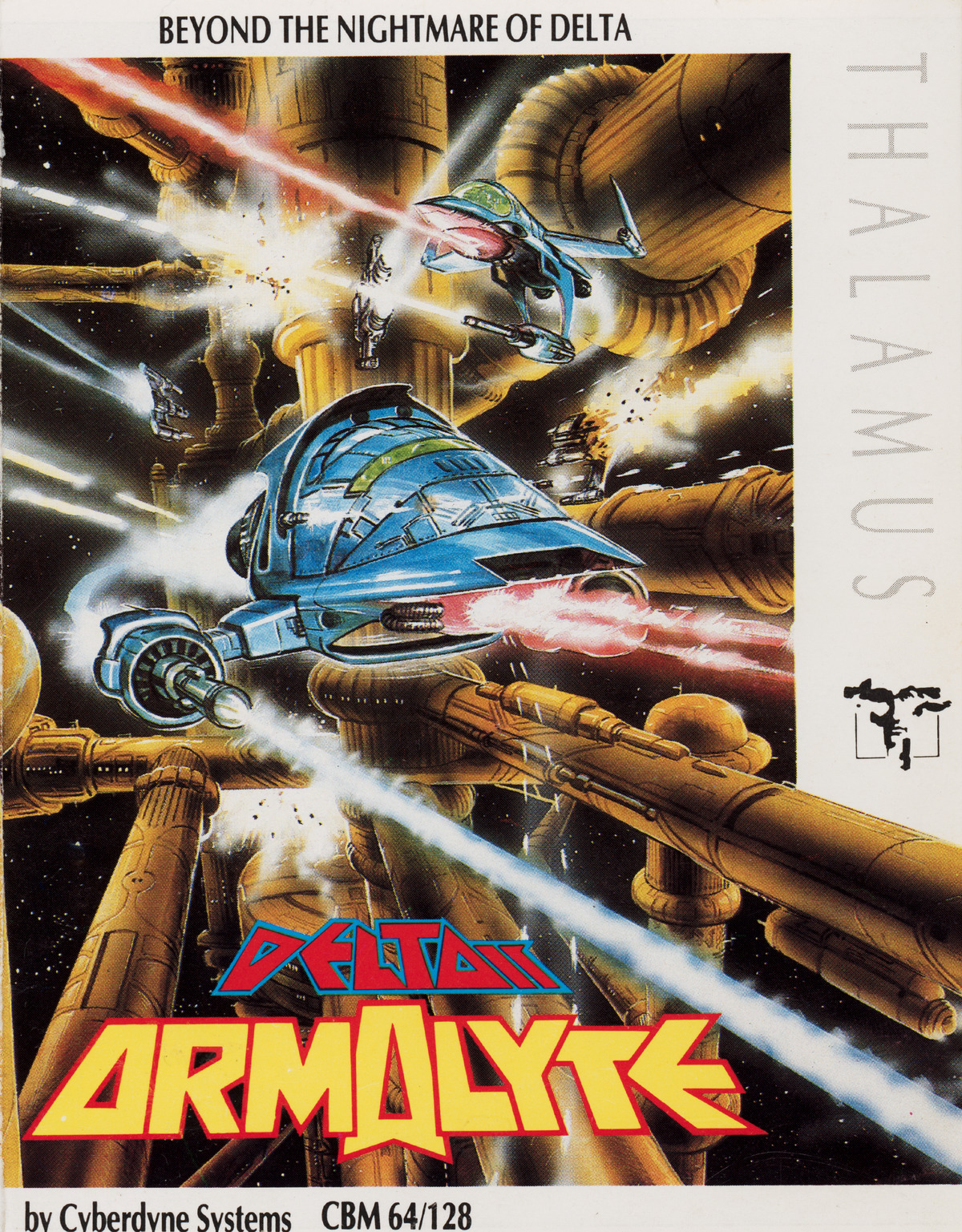
Armalyte (1988) represented Thalamus at its commercial zenith. Developed by Cyberdyne
Systems (Colin Dooley and Daniel Emmerson), the game was a horizontally scrolling shoot-em-up
of extraordinary technical and artistic quality. It reached number one in the European
software charts, a commercial validation that matched its critical acclaim.[1]
The timing was significant: 1988 was the year when 16-bit machines — the Amiga and the Atari ST —
were establishing themselves in the market. That a C64 game could reach number one in the European
charts against competition from these more powerful platforms was a testament to both Armalyte's
quality and the enduring size of the C64 audience. Thalamus had produced a game that was not
merely competitive on its own platform but genuinely compelling in the broader market.
Creatures and the Graphical Peak
If Armalyte represented Thalamus's commercial peak, Creatures (1990) represented its
technical and artistic peak. The Rowlands Brothers' platform game was a demonstration that
the C64 — a machine designed in 1982 and commercially active since 1983 — still had creative
potential that had barely been tapped.
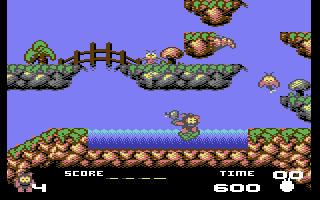
The graphics in Creatures were simply extraordinary. Richly detailed character sprites,
animated backgrounds, smooth scrolling, and a colour palette that seemed to exceed what the
hardware should be capable of producing. The Rowlands Brothers achieved this through meticulous
exploitation of the C64's sprite multiplexing capabilities, cycling colour registers with
precise timing to produce visual effects that appeared far beyond the machine's published
specification.[2]
Released in 1990, when the market had largely migrated to 16-bit platforms, Creatures
was a defiant statement: the C64 was not exhausted. The Rowlands Brothers returned with
Creatures II: Torture Trouble in 1992, pushing even further. These games are now
considered canonical examples of late-era 8-bit programming excellence.
Decline and Closure (1991–1993)
The forces that ultimately brought Thalamus down were structural and market-wide, not a failure
of ambition or quality. Newsfield Publications collapsed in 1991 under severe
financial pressure — a victim of the brutal economics of British magazine publishing and
changing market conditions as readers migrated from 8-bit to 16-bit platforms.[1]
Thalamus survived Newsfield's collapse initially, but the publisher faced mounting challenges:
a rapidly shrinking C64 software market, expensive and over-budget Amiga development projects
that generated minimal revenue, and the loss of the Zzap!64 promotional machinery that had
given the label its early visibility. Rising production costs and falling sales volumes made
the economics increasingly unworkable.
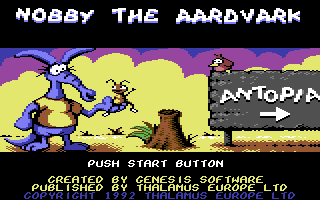
After releasing Nobby the Aardvark in 1993 — the final entry in its C64 catalogue —
Thalamus closed its doors in 1993, bringing to an end one of the most
artistically significant chapters in British C64 gaming history. The company left behind
fifteen C64 releases that, collectively, represent an unparalleled standard of quality for
a publisher of its size and lifespan.
Modern Revival — Thalamus Digital Publishing
The Thalamus name was not lost to history. Thalamus Digital Publishing Ltd
relaunched as an independent label, bringing the brand into the digital age. Active on
itch.io,
Thalamus Digital has released updated versions of classic titles across multiple platforms
including the C64, ZX Spectrum, Game Boy Color, and Amiga.
The revival represents a genuine continuation of the Thalamus spirit — a commitment to
quality retro gaming that respects the heritage of the original label while making its
titles accessible to new audiences. For fans who grew up with the original C64 releases,
Thalamus Digital Publishing is a welcome affirmation that the work produced between 1986
and 1993 remains worth celebrating, preserving, and playing.